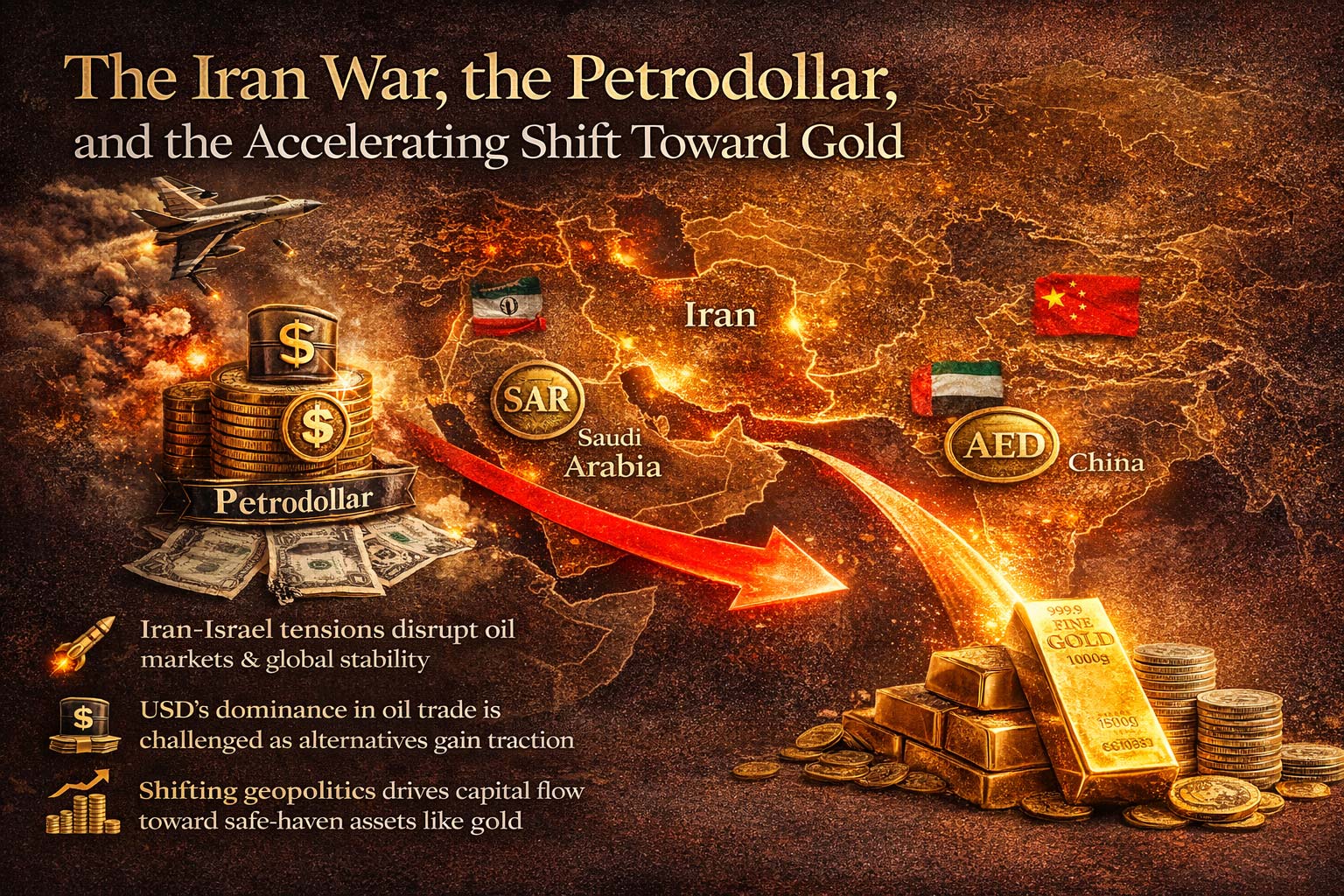
The Iran War, the Petrodollar, and the Accelerating Shift Toward Gold:
Why the Global Monetary System May Be Entering a Critical Transition
By Tome Fierre
Introduction: A Monetary System Under Pressure
For over half a century, the global financial system has rested on a quiet but powerful foundation: the petrodollar system. Oil—the world’s most strategic commodity—has been priced and settled primarily in U.S. dollars, reinforcing the dollar’s status as the world’s dominant reserve currency.
But today, a convergence of forces is beginning to challenge that structure:
- A rapidly escalating geopolitical conflict in Iran
- Record U.S. debt levels
- Persistent inflation and fiscal expansion
- And perhaps most importantly, a historic shift in central bank behavior
The emerging pattern is difficult to ignore: central banks are buying gold at the fastest pace in decades while gradually reducing reliance on U.S. Treasuries and dollar reserves.
The Iran war may not be the sole cause—but it could be the catalyst that accelerates an already underway transformation of the global monetary order.
The Petrodollar System: The Backbone of Dollar Dominance
Since the 1970s, the United States has benefited from an extraordinary structural advantage: oil transactions—particularly from major Middle Eastern producers—have been denominated in dollars.
This system created a reinforcing loop:
- Countries needed dollars to buy oil
- They accumulated dollar reserves
- Those reserves were recycled into U.S. Treasuries
- This financed U.S. deficits and strengthened dollar dominance
This structure allowed the U.S. to:
- Run persistent trade deficits
- Issue debt at relatively low cost
- Maintain global financial influence
But this system is not immutable. It relies heavily on:
- Stability in the Middle East
- Trust in U.S. financial and political institutions
- And the perception that the dollar is the safest store of value
All three are now under strain.
The Iran War: A Potential Inflection Point
The ongoing conflict involving Iran has already produced significant global economic disruptions:
- Major energy supply shocks and trade disruptions
- Rising inflationary pressures
- Currency volatility and market instability
The closure or disruption of key energy routes—particularly the Strait of Hormuz—has been described as one of the most severe global supply shocks in modern history.
This matters enormously for the petrodollar.
Why?
Because the petrodollar depends on predictable, stable oil flows under a U.S.-aligned geopolitical structure. When that structure fractures, so does confidence in the system that supports it.
War and the Fragility of Dollar-Based Energy Trade
Historically, wars in the Middle East have reinforced the petrodollar by increasing U.S. strategic influence. But this conflict may be different.
Instead of reinforcing U.S. dominance, the Iran war is:
- Increasing geopolitical fragmentation
- Encouraging alternative trade alliances
- Raising questions about dollar-based settlement systems
According to analysis cited by major financial institutions, the war could act as a “catalyst for erosion of the petrodollar” .
This is a profound shift.
Rather than strengthening the dollar’s role, the conflict may accelerate:
- Bilateral trade agreements in non-dollar currencies
- Regional energy trading blocs
- Alternative settlement systems outside the U.S. financial infrastructure
The Debt Factor: A Structural Weakness
At the same time, the U.S. fiscal position is deteriorating at an unprecedented pace.
- U.S. national debt has surpassed $39 trillion
- Interest payments are becoming one of the fastest-growing budget items
- Fiscal deficits remain structurally elevated
This matters because reserve currency status depends heavily on confidence in long-term fiscal sustainability.
When global reserve holders begin to question:
- The purchasing power of the dollar
- The stability of U.S. debt markets
- Or the political willingness to control deficits
They begin to diversify.
And that is exactly what is happening.
Central Banks Are Voting With Their Balance Sheets
Perhaps the most important signal in global monetary policy today is not rhetoric—it is behavior.
And the behavior is clear:
👉 Central banks are buying gold at record levels.
- Purchases have exceeded 1,000 metric tons annually in recent years
- 2026 is projected to see continued aggressive accumulation (~800 tons)
- Gold demand has been driven heavily by central banks and institutional investors
This is not speculative buying.
It is strategic.
Why Gold? The Strategic Case
Gold offers central banks something no fiat currency can:
- No counterparty risk
- Immunity from sanctions
- Independence from any single nation’s monetary policy
After the freezing of Russia’s reserves in 2022, many countries realized a critical truth:
👉 Dollar reserves can be politically weaponized.
As a result:
- China has dramatically increased gold holdings
- Emerging markets are reducing dollar exposure
- Central banks globally are rebalancing reserves
Surveys indicate:
- 73% of central banks expect to reduce dollar holdings
- 95% expect continued gold accumulation
De-Dollarization: From Theory to Reality
For years, “de-dollarization” was discussed as a theoretical possibility.
Today, it is observable policy.
Key drivers include:
- Sanctions risk
- Geopolitical fragmentation
- Fiscal concerns in the U.S.
- Rising multipolar economic blocs
The Iran war amplifies all of these dynamics simultaneously.
Energy, Currency, and Power
Energy markets are the hinge on which monetary systems turn.
If oil begins to trade in:
- Yuan
- Euro
- Or bilateral currency agreements
Then demand for dollars structurally declines.
The Iran conflict could accelerate:
- Non-dollar oil settlement agreements
- Regional energy trade systems
- Strategic alliances outside U.S. influence
This weakens one of the dollar’s most important pillars.
Inflation, War, and Monetary Policy
War has historically been inflationary.
The Iran conflict is no exception:
- Energy price shocks
- Supply chain disruptions
- Increased military spending
These forces:
- Pressure central banks to tighten policy
- Or force them into difficult trade-offs between inflation and growth
If central banks respond with:
- Rate cuts
- Quantitative easing
Then the case for gold strengthens dramatically .
The Dollar’s Paradox: Strength vs. Stability
In the short term, the dollar often strengthens during crises due to safe-haven demand.
But in the long term:
- Persistent deficits
- Monetary expansion
- Geopolitical overreach
Can undermine confidence.
This creates a paradox:
👉 The dollar can rise in the short term
👉 While weakening structurally over time
Silver: The Secondary Beneficiary
While gold dominates reserve strategies, silver plays a secondary but important role.
Silver benefits from:
- Monetary demand (store of value)
- Industrial demand (energy transition, electronics)
In a de-dollarizing world:
- Silver often follows gold
- But with greater volatility and upside potential
The Bigger Picture: A Multipolar Monetary System
What we are witnessing may not be the “end” of the dollar—but rather:
👉 The transition to a multipolar monetary system
In this system:
- The dollar remains dominant—but less absolute
- Gold plays a larger reserve role
- Regional currencies gain influence
- Settlement systems diversify
Is the Petrodollar Ending?
The petrodollar is unlikely to disappear overnight.
But it does not need to collapse to lose influence.
Even a gradual shift:
- From 100% dollar-based oil trade
- To 70%, 60%, or 50%
Would have profound implications.
Implications for Investors and Markets
If these trends continue, we should expect:
- Higher Gold Prices
Driven by:
- Central bank demand
- Geopolitical risk
- Currency debasement
- Increased Volatility
- Currency markets
- Bond markets
- Commodity markets
- Structural Pressure on U.S. Treasuries
As:
- Foreign demand declines
- Domestic financing burdens increase
Conclusion: A System in Transition
The Iran war is not the sole cause of the pressures facing the dollar—but it may be the accelerant.
It exposes vulnerabilities in:
- Energy supply chains
- Geopolitical alliances
- The dollar-based financial system
At the same time, central banks are making a clear statement:
👉 They are preparing for a world where the dollar is no longer the only anchor.
Gold is no longer just a hedge.
It is becoming a strategic monetary asset once again.
The question is not whether change is coming.
The question is how fast—and how far—it goes.