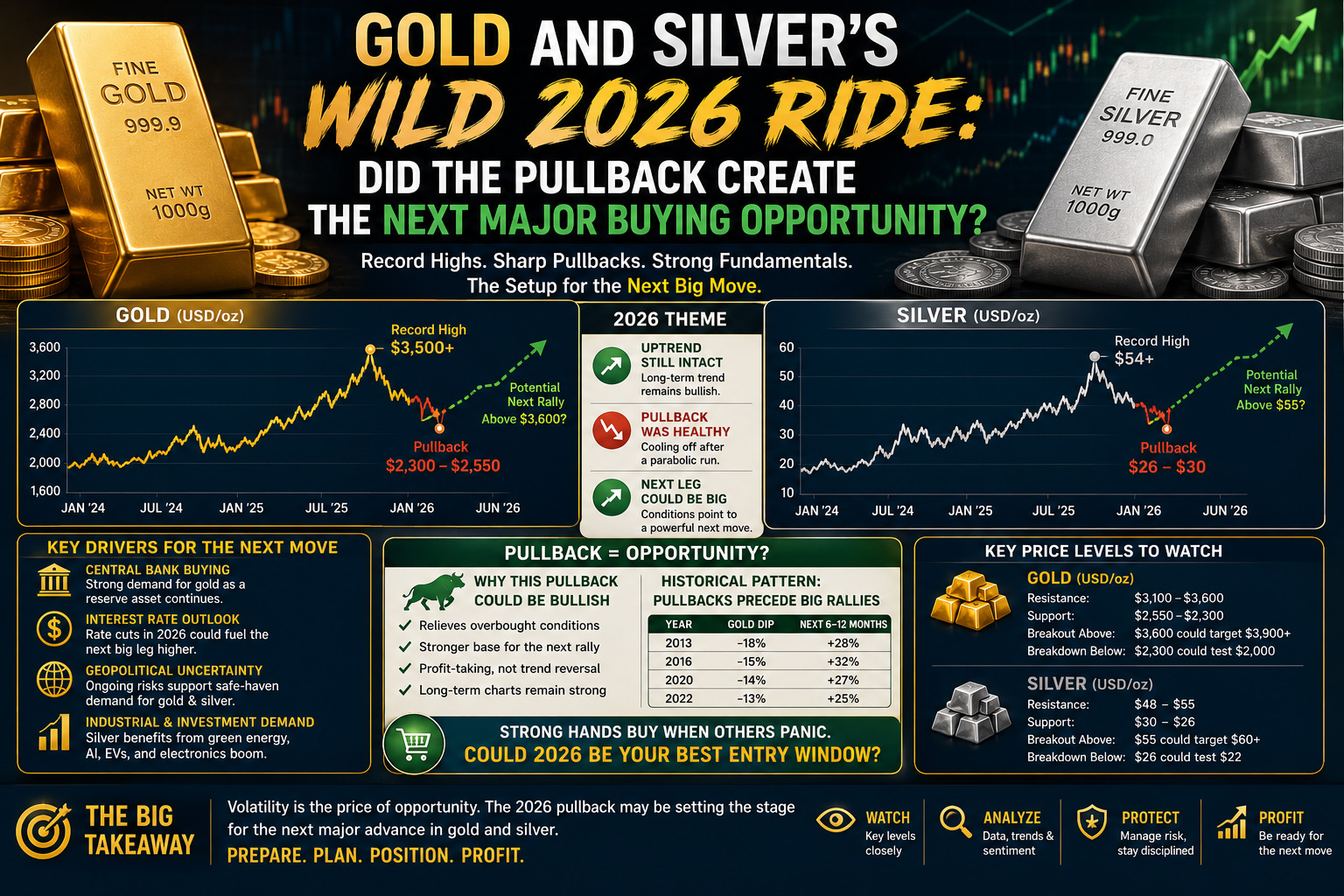
Gold and Silver’s Wild 2026 Ride: Did the Pullback Create the Next Major Buying Opportunity?
Updated August 10, 2026
Gold and silver have taken investors on one of the most extraordinary rides in modern precious-metals history.
Gold entered 2026 with enormous momentum, surged to nearly $5,600 per ounce, then suffered a brutal correction that briefly pushed prices below $4,000. Silver was even more dramatic, exploding above $121 per ounce before losing roughly half its value.
For investors who bought near the top, the correction was painful.
For investors who had been waiting for an opportunity to own physical gold or silver, however, the story may look very different.
As of August 10, gold has begun moving higher again, reaching approximately $4,376.56 per ounce, its highest level since early June. Silver has recovered to approximately $65.50 per ounce.
Neither metal has returned to its January record.
And that may be precisely what makes the current environment interesting.
If the fundamental forces that drove gold and silver to record prices remain intact—and particularly if central banks continue accumulating gold at the historically elevated levels seen in recent years—the enormous correction could eventually be viewed not as the end of the precious-metals bull market, but as one of its more significant buying opportunities.
That certainly does not mean prices cannot fall again.
They can.
But there is an important difference between buying after an almost vertical price surge and considering an investment after the market has already experienced a 20%, 30% or even 50% correction.
The risk/reward equation changes.
And in August 2026, investors are beginning to ask whether gold and silver are entering the next phase of a much larger secular precious-metals story.
The Precious-Metals Boom Started Long Before 2026
Gold’s extraordinary run did not begin in January.
The foundations were built over several years.
Investors increasingly became concerned about:
- Growing sovereign debt
- Persistent government deficits
- Currency purchasing power
- Inflation
- Geopolitical instability
- Dependence on the U.S. dollar
- Central-bank reserve diversification
- Financial-system risk
- Global political uncertainty
At the same time, another enormously important buyer entered the market on a sustained basis:
central banks.
And unlike momentum traders, retail investors or hedge funds, central banks generally are not purchasing gold because they expect to sell it next week.
They are managing national reserves.
That distinction matters enormously.
The Central-Bank Gold Story May Be the Most Important Part of the Bull Case
Central-bank demand has fundamentally changed the gold market.
According to the World Gold Council, central banks have accumulated an average of approximately 1,000 metric tonnes of gold annually over the past four years.
That compares with an average of roughly 500 tonnes per year during the preceding decade.
In other words, the pace of official-sector accumulation has approximately doubled.
That is not simply a short-term trading phenomenon.
It represents a potentially significant change in the way national reserve managers think about gold.
Why?
Because central banks increasingly view gold as a way to diversify reserves, reduce concentration risk, protect against geopolitical and financial uncertainty and maintain exposure to an asset that does not depend on another country’s promise to pay.
The World Gold Council’s 2026 survey produced one particularly striking statistic:
A record 45% of responding central banks said they expect to increase their own gold holdings over the next 12 months.
Additionally, 89% expect global central-bank gold reserves to increase.
That does not guarantee that every central bank will buy.
Nor does it guarantee another record year.
In fact, central-bank purchasing was uneven during the first half of 2026.
But Q2 demand recovered sharply.
Central banks purchased approximately 289 tonnes of gold during the second quarter, according to the World Gold Council, returning buying activity to levels similar to the elevated quarterly purchases that have characterized much of the past four years.
That may be one of the strongest arguments for investors who believe the recent correction created an opportunity.
China Is Buying Again—and Accelerating
China remains particularly important.
On August 10, Reuters reported that China’s central bank had stepped up gold purchases during July, adding its largest amount of bullion to reserves since October 2023.
China’s actions matter for reasons beyond the ounces purchased in any individual month.
Large economies hold enormous foreign-exchange reserves.
Traditionally, much of those reserves have been concentrated in sovereign debt and dollar-denominated assets.
If China and other emerging-market central banks gradually increase the percentage allocated to gold, even relatively small portfolio changes can represent enormous physical demand.
The long-term question therefore isn’t:
Will China buy gold this month?
It is:
What percentage of global reserves will eventually be held in gold?
If that percentage continues rising, central banks could remain a powerful source of underlying demand for years.
Why Central-Bank Buying Changes the Investment Equation
Consider the difference between two markets.
In the first market, prices rise primarily because speculators believe prices will continue rising.
That market can collapse when sentiment changes.
In the second market, speculative demand exists—but underneath it is sustained accumulation from institutions with extraordinarily long investment horizons.
That second market can still experience violent corrections.
Gold proved that in 2026.
But structural buyers can potentially provide a longer-term foundation beneath the price.
A Reuters poll of 29 analysts and traders published July 28 found that most respondents continued to expect central-bank buying to support gold even after analysts reduced their near-term forecasts following the correction. The median forecast for gold in 2026 was approximately $4,509 per ounce.
The same Reuters analysis noted that market participants generally believe several core structural drivers remain intact, including government debt concerns, geopolitical tensions and questions surrounding currency credibility.
That is an important distinction.
The price corrected.
The question is whether the fundamental thesis did.
So far, there is a reasonable argument that it did not.
January 2026: When Gold and Silver Went Vertical
To understand why today’s prices may look more attractive, consider how extreme January became.
Gold surged rapidly through levels that only months earlier had seemed almost unimaginable.
The rally ultimately culminated on January 29 when spot gold reached approximately:
$5,594.82 per ounce
Silver’s move was even more dramatic.
The metal ultimately reached approximately:
$121.64 per ounce
By that point, precious metals were not simply rising.
They were effectively going vertical.
That created a dangerous environment for new buyers.
When nearly everyone believes an asset must continue higher, fundamentals can temporarily become secondary to momentum.
Investors begin buying because prices are increasing.
Short-term traders enter.
Leverage increases.
Options activity increases.
Headlines attract retail buyers.
Forecasts become progressively more aggressive.
Eventually, everyone who wants to buy immediately has already bought.
That is when markets become vulnerable.
Then Came the Correction
Gold eventually fell below $4,000 per ounce in late June.
From the January high near $5,595, that represented a decline approaching 30%.
Silver’s correction was considerably worse.
From above $121, silver ultimately traded back into the upper-$50 range.
That represented a decline of roughly 50% or more.
Those are enormous moves.
But they also accomplished something important.
They removed much of the speculative excess from the market.
Investors who had chased prices sold.
Leveraged positions were reduced.
Momentum reversed.
Fear of missing out was replaced by fear of losing money.
In many markets, that transition is exactly what eventually creates more attractive entry points.
Why the Pullback Happened
The correction wasn’t random.
Several important variables changed.
Interest-Rate Expectations Shifted
Gold produces no interest.
When investors believe interest rates will remain high—or rise—the opportunity cost of holding gold increases.
Inflation concerns and higher energy prices caused financial markets to reconsider earlier expectations for easier Federal Reserve policy.
That pressured precious metals.
Even today, interest rates remain one of the most important risks to the bullish gold thesis.
Reuters reported on August 10 that markets were assigning meaningful probabilities to additional Federal Reserve rate increases. Higher rates generally work against gold because investors can earn more from interest-bearing securities.
The Dollar Strengthened
Gold and silver are primarily priced internationally in U.S. dollars.
A stronger dollar makes metals more expensive for buyers using other currencies and frequently pressures commodity prices.
Investors Took Profits
Many long-term precious-metals investors entered positions years before 2026.
Someone who bought silver at $20, $25 or $30 had an enormous incentive to take profits when prices moved above $100.
Gold investors were sitting on similarly extraordinary gains.
Profit-taking is not evidence that a bull market is permanently over.
It is often a natural part of one.
Speculative Positions Unwound
Momentum had helped drive precious metals higher.
Then it amplified the decline.
Silver was particularly vulnerable because its market is much smaller than gold’s and is more sensitive to both investment and industrial sentiment.
Why the Pullback Could Be More Attractive to Buyers
This is where the 2026 story becomes particularly interesting.
Buying gold at $5,500 after a huge vertical rally is one proposition.
Buying after the market has already experienced a nearly 30% correction is another.
Likewise, buying silver above $120 after an extraordinary speculative run is very different from evaluating silver around $60-$70 after approximately half of the peak valuation has disappeared.
That does not make either metal inexpensive.
Historical comparisons remain complicated because the economic environment itself has changed.
But the correction gives potential buyers something they did not have in January:
a significantly lower entry point without necessarily requiring the long-term bullish thesis to have changed.
UBS made a similar argument in August.
The bank said it expects gold to reach approximately $5,000 during the first half of 2027, while acknowledging meaningful near-term risks. UBS specifically characterized periods of weakness around $4,000 or below as potential opportunities for investors seeking strategic gold exposure.
No forecast should be treated as a guarantee.
But it demonstrates that the concept of buying into major gold weakness is not confined to retail precious-metals enthusiasts.
Large institutional strategists are examining the same possibility.
What Happens If Gold Returns to Its Previous High?
This provides an interesting way to think about the opportunity mathematically.
Gold around $4,375 remains roughly 22% below its January record near $5,595.
If gold simply returned to its former record—not exceeded it—the percentage gain from current levels would be substantial.
That is very different from buying at $5,500 and requiring gold to establish entirely new records before generating meaningful appreciation.
The same concept is even more dramatic with silver.
Silver around $65 remains approximately 46% below its $121-plus January record.
A return to the previous high would therefore represent a very large percentage move.
Again, there is absolutely no guarantee that either metal will revisit its old high.
But the pullback has materially changed the potential upside required simply to return to levels the market has already demonstrated it can reach.
Silver May Offer the More Aggressive Opportunity
Gold and silver should not be treated as identical investments.
Gold is primarily a monetary asset.
Silver is both a monetary metal and an industrial commodity.
That makes silver considerably more volatile.
When precious-metals markets rise strongly, silver can outperform gold dramatically.
When conditions deteriorate, silver can decline much faster.
Investors experienced both sides of that equation during 2026.
But silver has something else supporting the longer-term argument:
The physical market remains in deficit.
The Silver Institute expects total 2026 silver demand of approximately 1.11 billion ounces.
Mine production is expected to remain essentially flat.
And the organization projects the structural silver deficit to widen to approximately:
46.3 million ounces.
Coin and net bar demand is forecast to increase approximately 18% in 2026.
That is a potentially important fundamental backdrop.
A declining price normally sends a signal that supply is exceeding demand.
But silver presents a more complicated picture.
The metal can decline because investment sentiment and macroeconomic expectations weaken even while the physical market remains structurally tight.
That disconnect is one reason some precious-metals investors find the post-correction silver market particularly interesting.
Silver Does Have Risks
The bullish silver case should not ignore several important counterarguments.
Industrial demand is expected to soften in certain areas during 2026.
The Silver Institute forecasts overall industrial silver demand to decline, driven largely by changes in photovoltaic applications.
Solar manufacturers have made considerable progress reducing the amount of silver required in individual cells, a process commonly called “thrifting.”
At high enough silver prices, manufacturers also have a strong financial incentive to substitute other materials wherever technologically possible.
That means the bull case cannot simply be:
“Silver is scarce, therefore silver must rise.”
Commodity markets are more complicated.
But the combination of flat mine production, continued investment demand and a structural deficit remains significant.
Gold Versus Silver: Which Could Be the Better Buy?
The answer depends on what an investor wants.
Gold may appeal more to buyers seeking:
- Lower volatility relative to silver
- A monetary reserve asset
- Central-bank demand
- Global liquidity
- Wealth preservation
- Less dependence on industrial cycles
Silver may appeal more to buyers seeking:
- Greater upside potential
- A lower dollar cost per ounce
- Exposure to both precious-metals and industrial demand
- Potential benefits from structural supply deficits
- Greater price sensitivity during a strong metals bull market
The tradeoff is straightforward:
Silver’s potential upside comes with substantially greater volatility.
Investors witnessed that vividly when silver went from above $121 to below $60 within months.
Another Reason the Central-Bank Story Matters: Governments Are Not Trading the Chart
A private investor might buy gold at $4,000 and sell it at $4,500.
Central banks operate differently.
Reserve managers generally think in years and decades.
Gold serves functions within sovereign reserves that have little to do with whether the metal is up or down during a particular week.
The World Gold Council says the principal reasons central banks continue to value gold include:
- Reserve diversification
- Long-term store of value
- Performance during crises
- Protection from geopolitical uncertainty
- Reduced dependence on other financial assets
A record share of central-bank survey respondents—45%—expects to increase their own holdings during the coming year.
If those intentions translate into actual purchases, one of the strongest structural supports beneath gold could persist.
And if central-bank accumulation were to accelerate back toward—or beyond—the extraordinary levels of recent years, the bullish implications could become considerably stronger.
The Bullish Scenario for the Rest of 2026 and 2027
Imagine several things occurring simultaneously.
Central banks continue buying.
Economic growth weakens.
Inflation gradually moderates.
Bond yields decline.
The Federal Reserve eventually moves toward easier monetary policy.
The U.S. dollar weakens.
Geopolitical tensions remain elevated.
Government debt continues increasing.
Investors return to gold ETFs.
Silver remains in structural deficit.
In that environment, precious metals could potentially make another serious attempt at their previous highs.
This scenario is not merely theoretical.
UBS currently expects gold to reach around $5,000 during the first half of 2027.
Meanwhile, the July Reuters survey showed analysts still expecting central-bank purchases and concerns about fiscal sustainability to provide underlying support to gold despite reduced short-term forecasts.
The Bearish Scenario Investors Should Not Ignore
There is another possibility.
Inflation could remain stubborn.
Interest rates could rise.
Treasury yields could stay elevated.
The dollar could strengthen.
Central banks could reduce gold purchases.
Global economic growth could weaken enough to hurt industrial silver demand.
Investors could continue withdrawing money from precious-metals ETFs.
Under that scenario, gold could retest—or break—its previous lows.
Silver could experience another major decline.
That is why investors should be careful about treating the word “opportunity” as synonymous with “bottom.”
Nobody knows whether the June lows represented the final bottom.
Markets rarely provide that certainty in real time.
A Different Approach: Buying in Stages
For someone who believes in the long-term precious-metals thesis but cannot predict the short-term price, one approach is staged purchasing rather than attempting to identify the exact bottom.
Instead of investing an entire desired allocation at one price, a buyer might spread purchases over time.
That does not eliminate risk.
But it reduces the importance of selecting the perfect day.
It also helps avoid one of the most common mistakes made during commodity bull markets:
chasing dramatic price spikes because of fear of missing out.
The investor purchasing silver around $60-$70 after a 50% correction is making a fundamentally different decision from the investor who felt compelled to buy above $120 because prices appeared unstoppable.
Physical Bullion Versus Paper Precious Metals
Investors interested in precious metals also need to decide what they actually want to own.
Physical bullion includes:
- Gold bars
- Silver bars
- American Gold Eagles
- American Silver Eagles
- Canadian Maple Leafs
- Other sovereign bullion coins
- Privately minted rounds and bars
Physical metals provide direct ownership.
They do not depend upon the solvency of an ETF provider, broker or financial institution.
But physical bullion also introduces considerations such as:
- Storage
- Insurance
- Dealer premiums
- Bid/ask spreads
- Authentication
- Shipping
- Security
Exchange-traded products may provide easier liquidity, but they are not identical to possessing physical metal.
The correct vehicle depends on the investor’s purpose.
Interested in Buying Gold or Silver After the Pullback?
For investors who believe the long-term precious-metals cycle remains intact, the 2026 correction has created prices dramatically below January’s speculative highs.
That does not mean gold or silver cannot decline further.
But buyers today are no longer entering after an uninterrupted vertical rally.
They are considering precious metals after one of the largest corrections of the current cycle—while central-bank demand remains historically elevated and the silver market remains structurally undersupplied.
➜ Looking to Buy Physical Gold, Silver or Bullion?
Visit BullionBankers.com to explore precious-metals information, physical bullion and opportunities to purchase gold and silver.
Before buying, understand the spot price, premium over spot, dealer spread, liquidity and resale market for the specific product being considered.
Already Own Gold or Silver? Higher Prices May Also Create a Selling Opportunity
Not everyone examining precious metals today is a buyer.
Millions of Americans own gold or silver that was:
- Purchased decades ago
- Inherited from parents or grandparents
- Acquired as part of a coin collection
- Stored away and forgotten
- Purchased when gold and silver were dramatically less expensive
Despite the correction, current precious-metals prices remain historically elevated.
That means old coins, bullion and inherited collections may be worth substantially more than owners realize.
An important warning:
Do not assume an old coin is worth only its metal content.
Certain coins possess numismatic or collector value substantially above melt value.
Date, mintmark, rarity, condition and professional grading can all matter.
➜ Have Gold, Silver, Bullion or Coins to Sell?
Get an estimate from CashForCoins.net for gold coins, silver coins, bullion, rare coins and collections.
Understanding the value before selling is particularly important when dealing with inherited or older collections.
Frequently Asked Questions About Buying Gold and Silver in 2026
Is gold a good buy after the 2026 correction?
Gold has fallen substantially from its January 2026 record, potentially providing a more attractive entry point for investors who believe its long-term structural drivers remain intact.
Those drivers include historically elevated central-bank accumulation, geopolitical uncertainty, sovereign-debt concerns and demand for reserve diversification. However, gold can still fall further, particularly if interest rates and the U.S. dollar rise.
How high did gold get in 2026?
Spot gold reached approximately $5,594.82 per ounce in late January 2026 before experiencing a major correction. As of August 10, it had recovered to approximately $4,376.56.
How high did silver get?
Silver reached an all-time high above $121 per ounce on January 29, 2026 before falling dramatically. The Silver Institute confirms the record move above $121.
What is silver trading at now?
Spot silver traded around $65.50 per ounce on August 10, 2026.
Are central banks still buying gold?
Yes. Central-bank activity has been uneven in 2026, but buying recovered strongly to approximately 289 tonnes in Q2. Central banks have accumulated an average of roughly 1,000 tonnes annually during the past four years, approximately twice the preceding decade’s average.
Are central banks buying gold at record levels?
Recent years have represented an historically elevated period of central-bank accumulation, although 2026 itself should not yet be characterized as a new annual record.
The more important forward-looking statistic may be that a record 45% of central banks surveyed by the World Gold Council expect to increase their own gold holdings over the next 12 months.
Why are central banks buying gold?
Major reasons include reserve diversification, protection against geopolitical and financial uncertainty, gold’s historical role as a store of value and reducing excessive concentration in other reserve assets.
Could gold return to $5,000?
It could, although there is no guarantee. UBS said in August that it expects gold to reach approximately $5,000 during the first half of 2027.
Could gold return to $5,600?
Gold has already demonstrated that it can trade near that level, but whether it returns depends on interest rates, inflation, central-bank demand, investor flows, the dollar, geopolitical conditions and broader economic developments.
A previous high should never be assumed to be a future price target.
Is silver currently in a supply deficit?
Yes. The Silver Institute expects the structural silver-market deficit to widen to approximately 46.3 million ounces in 2026, with mine production essentially flat.
Is silver a better buying opportunity than gold?
Silver may offer greater percentage upside during a strong precious-metals rally, but it also carries considerably greater volatility.
Gold generally behaves more like a monetary reserve asset, while silver is affected by both investment demand and industrial conditions.
Why did silver fall so much more than gold?
Silver has a smaller market and greater exposure to speculative activity and industrial demand. These characteristics frequently cause silver to amplify precious-metals market movements in both directions.
Should I buy gold all at once?
Some investors prefer staged purchases because it reduces dependence on selecting a single entry price. That approach cannot eliminate losses, but it can reduce the risk associated with buying immediately before a short-term correction.
Should I buy coins or bars?
Bars often provide lower premiums per ounce, particularly at larger sizes.
Sovereign bullion coins can provide strong recognition and liquidity.
The right choice depends on investment size, storage requirements, resale considerations and dealer premiums.
Where can I buy gold and silver?
Those interested in physical precious metals can visit BullionBankers.com to learn more about buying gold, silver and bullion.
Should I sell old gold and silver while prices remain high?
That depends upon your financial circumstances and your view of future precious-metals prices.
However, people who purchased or inherited metals at much lower historical prices may currently be sitting on substantial appreciation.
Owners considering a sale can request an estimate from CashForCoins.net.
What is the biggest risk to gold right now?
One of the most significant near-term risks is sustained high interest rates.
Gold does not pay interest, so high yields can increase the attractiveness of bonds and cash relative to bullion. Reuters reported on August 10 that interest-rate expectations remain an important influence on the market.
What could send gold substantially higher?
Potential catalysts include renewed central-bank accumulation, falling interest rates, a weaker dollar, deteriorating fiscal conditions, geopolitical instability, renewed ETF inflows and increased investor demand for alternative stores of value.
Final Thoughts: The Correction May Be the Most Important Part of the 2026 Gold Story
It is easy to look at precious metals only when they are making new highs.
But historically, some of the more interesting opportunities occur after excitement disappears.
January 2026 was characterized by extraordinary enthusiasm.
Gold approached $5,600.
Silver exceeded $121.
Buyers were chasing prices.
Then everything changed.
Gold suffered a correction approaching 30%.
Silver lost approximately half its value.
Momentum disappeared.
Speculators exited.
And sentiment became dramatically more cautious.
Yet something important did not disappear:
The longer-term case for precious metals.
Central banks have accumulated roughly 1,000 tonnes of gold per year on average during the past four years, approximately twice the average pace of the preceding decade.
Central-bank buying rebounded to 289 tonnes in Q2 2026.
A record 45% of surveyed central banks expect to increase their own gold holdings during the next year.
China has recently accelerated its own purchases.
And silver remains in a projected 46.3-million-ounce structural supply deficit.
That does not prove prices will rise.
But it creates an intriguing situation.
Gold and silver have undergone massive corrections while several of the fundamental forces that helped produce the original bull market remain in place.
If central banks continue accumulating gold at historically elevated levels…
If investment demand returns…
If interest-rate pressure eventually eases…
If sovereign debt and currency concerns continue…
And if silver remains structurally undersupplied…
Then the 2026 pullback may someday look very different than it does today.
Rather than being remembered as the end of the precious-metals run, it could ultimately be remembered as the correction that created the next major buying opportunity.
Ready to Buy Gold or Silver?
If you believe precious metals have additional room to run and want to explore physical ownership:
Research gold, silver, bullion coins and physical precious-metal ownership before making a purchase.
Have Gold, Silver or Coins to Sell?
If the extraordinary rise in precious-metal values has you considering taking profits or selling an inherited collection:
Learn what your gold, silver, bullion, rare coins or coin collection may be worth before deciding whether to sell.