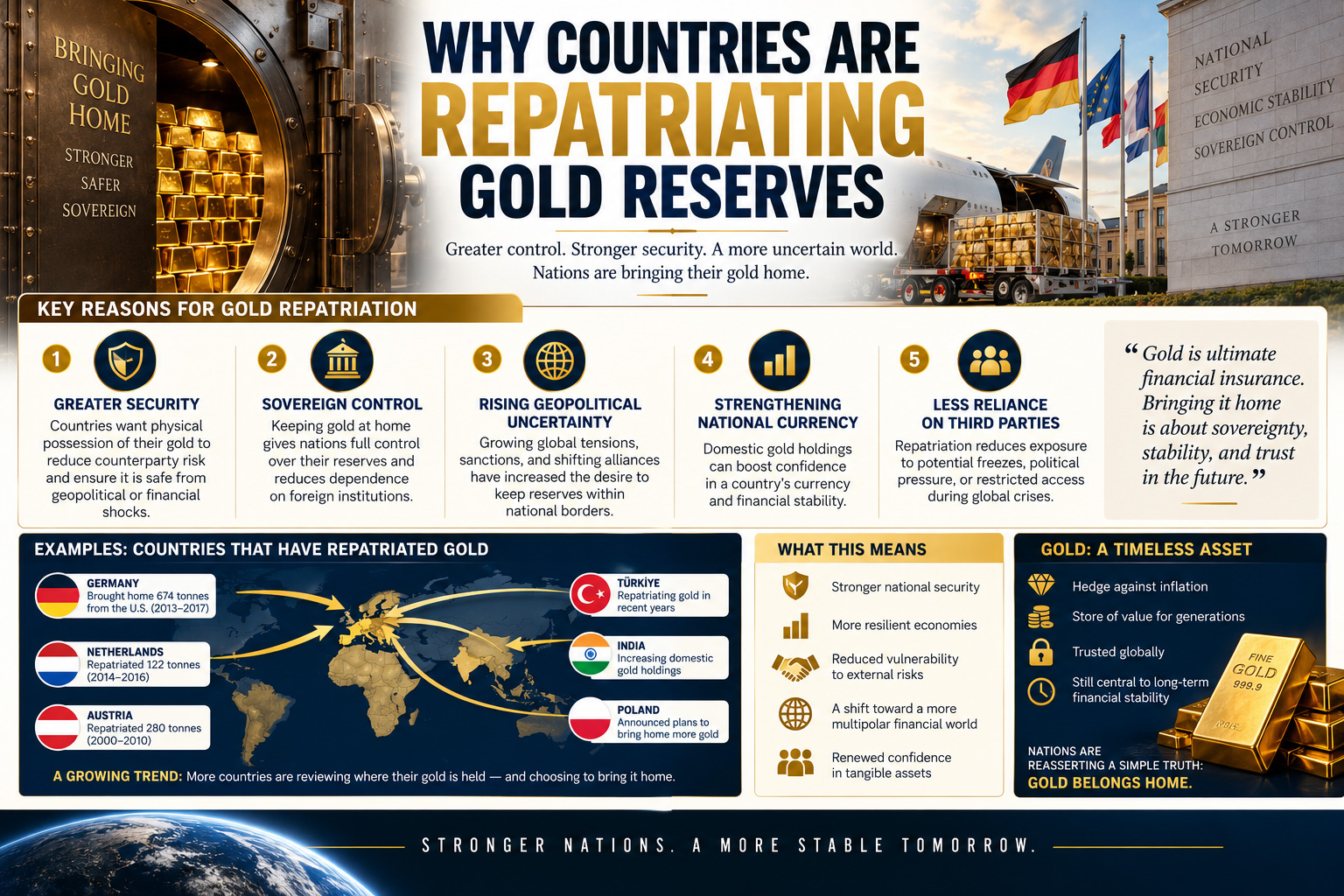
Why Countries Are Moving Gold Reserves: Central Bank Repatriation, U.S. Debt and the Future of Gold
Bullion Bankers Research | Updated September 2026
For decades, the location of a country's gold reserves received relatively little public attention.
That is changing.
Central banks around the world are taking a closer look at where their physical gold is stored, which governments have legal jurisdiction over those reserves, how quickly the metal could be accessed during a financial crisis, and whether concentrating national wealth in foreign vaults creates risks that were previously considered remote.
Some countries have physically repatriated gold. Others have reduced holdings in New York or London and acquired replacement bullion elsewhere. Still others are publicly debating whether reserves held abroad should be returned home.
The trend has led to a growing search question among investors:
Why are countries bringing their gold reserves home?
The answer is more complicated than simple distrust of the United States.
Central banks are responding to several overlapping forces, including geopolitical tensions, financial sanctions, sovereign debt growth, inflation risk, reserve diversification, custody risk and the desire to maintain direct control over assets during periods of extreme financial stress.
Recent moves by the Netherlands and France, together with earlier repatriation programs by Germany, Austria, Poland, Hungary, India and other nations, suggest that gold's physical location is becoming part of national reserve strategy rather than merely a logistical decision. (World Gold Council)
What Is Gold Repatriation?
Gold repatriation generally refers to a country moving gold that is stored abroad back into domestic custody.
However, not every recent change in central bank gold storage qualifies as literal repatriation.
A central bank can physically ship bullion home. It can move gold from one foreign custodian to another. It can also sell bars located in one country and simultaneously acquire an equivalent quantity of bullion in another market.
This distinction matters because recent transactions increasingly appear to be about location strategy, not simply bringing everything home.
The World Gold Council notes that central banks are balancing three major considerations: custody risk, physical accessibility and market liquidity. (World Gold Council)
Why Is So Much Foreign Gold Stored in the United States?
The Federal Reserve Bank of New York operates one of the world's largest official gold vaults.
As of 2024, the vault held approximately 507,000 gold bars weighing about 6,331 metric tons. Much of this gold belongs not to the Federal Reserve itself, but to foreign governments, central banks and international institutions. (Federal Reserve Bank of New York)
New York became a natural location for foreign gold during and after World War II because the United States was geographically removed from European conflict and because New York became a center of the postwar international monetary system.
Foreign custody also provides practical advantages.
Gold stored in a major financial center can potentially be sold, pledged, swapped or transferred more efficiently than metal held deep inside a country's domestic vault system.
The New York Fed also states that deposited bars are carefully weighed and recorded and that the exact bars deposited are returned when an account holder withdraws its metal. (Federal Reserve Bank of New York)
For decades, those advantages outweighed most concerns about foreign custody.
Today, some central banks are reassessing that calculation.
The Netherlands Moves Gold Away From New York
One of the clearest examples came in September 2026.
De Nederlandsche Bank, the Dutch central bank, announced that it had restructured approximately 86 metric tons of gold previously held in the United States and Canada.
DNB explicitly cited increasing geopolitical unrest, crisis preparedness and the need to improve the liquidity and tradability of its gold reserves. (De Nederlandsche Bank)
Importantly, the Netherlands did not simply ship 86 tons of bullion back home.
Approximately 59 tons held in New York were sold and replaced with gold in London that met international market standards. More than 27 tons were physically moved from North America to the Netherlands, while a similar quantity of suitable gold was shifted from the Netherlands to London. (De Nederlandsche Bank)
Before the change, New York held 31.3% of Dutch reserves. After the transaction, that percentage fell to 18.5%. London's share increased from 18.1% to 32.1%, making London the largest individual storage location for Dutch gold. (De Nederlandsche Bank)
This is important because it shows that the modern trend is not necessarily about abandoning foreign storage.
It is about reducing concentration and improving resilience.
The Dutch central bank specifically stated that gold held in London can be deployed more quickly during a severe crisis because London remains the world's most important physical gold trading center. (De Nederlandsche Bank)
France Removes 129 Tons of Gold Exposure From New York
France provides another important recent example.
The Banque de France disclosed that 129 metric tons of French gold had been held in New York and did not meet the modern bullion standard the central bank wanted for its reserve inventory.
Rather than physically transporting and refining the bars, the Banque de France sold the New York gold and purchased equivalent high-standard gold in Europe.
France's total gold reserves remained unchanged at approximately 2,437 metric tons. (Banque de France)
The French central bank described the transaction primarily in technical and reserve-management terms rather than as a political break with the United States.
That distinction should not be ignored.
At the same time, the practical result was that a substantial French gold position previously held in New York was replaced with bullion held in Europe.
Germany Has Already Repatriated Hundreds of Tons
Germany has one of the best-known gold repatriation histories.
Between 2013 and 2017, Germany transferred hundreds of tons of bullion from New York and Paris to Frankfurt. The broader German strategy was designed to increase the proportion of national gold reserves held domestically while retaining meaningful positions in major international financial centers. (World Gold Council)
Germany has not withdrawn all of its gold from the United States.
As of December 31, 2025, the Bundesbank reported approximately:
| Storage Location |
German Gold Held |
| Frankfurt |
1,710 tonnes |
| Federal Reserve Bank of New York |
1,236 tonnes |
| Bank of England, London |
404 tonnes |
Germany's total reported gold holdings were approximately 3,350 tonnes. (Bundesbank Publications)
What changed more recently is the public discussion.
In 2025, German lawmakers and taxpayer advocates renewed calls to reconsider the large quantity of German gold stored in New York. Concerns cited in that debate included changing transatlantic relations, questions about U.S. institutions and whether national reserves should remain under foreign jurisdiction during periods of political uncertainty. The Bundesbank, however, continued to publicly express confidence in the New York Federal Reserve as a custodian. (Reuters)
Germany therefore illustrates an important distinction.
Political calls for repatriation are not the same as a central bank announcing a new repatriation program.
Italy Has More Than 1,000 Tons of Gold in the United States
Italy is also closely watched because it owns one of the world's largest national gold reserves.
Banca d'Italia reports total holdings of approximately 2,452 metric tons.
Its current geographical distribution is:
| Location |
Share |
Gold |
| Italy |
44.86% |
1,100 tonnes |
| United States |
43.29% |
1,061.5 tonnes |
| Switzerland |
6.09% |
149.3 tonnes |
| United Kingdom |
5.76% |
141.2 tonnes |
(Bank of Italy)
Banca d'Italia explains that diversification reduces custody risk and that storing gold in major financial centers allows reserves to be mobilized more quickly if necessary. (Bank of Italy)
Italy has not announced a wholesale repatriation of its American holdings, but the sheer amount stored in the United States makes it relevant to the broader European debate over reserve sovereignty and custody.
This Trend Extends Far Beyond the United States
Gold repatriation is not a uniquely American issue.
The World Gold Council identifies numerous countries that have changed storage arrangements since 2000.
Germany transferred gold from both London and New York. The Netherlands moved 122.5 tons from New York to Amsterdam in 2014. Austria transferred approximately 90 tons from London between 2015 and 2018. Hungary and Poland increased domestic storage. Serbia reportedly brought roughly 13 tons home during 2021 and 2022. India has progressively increased domestic storage since 2022. (World Gold Council)
The lesson is broader than "countries are pulling gold out of America."
A more accurate conclusion is that central banks are becoming more deliberate about where their gold is located and under whose jurisdiction it sits.
Why Gold Custody Matters More After Financial Sanctions
A major change in reserve management has been the increasing use of financial sanctions.
Foreign-exchange reserves, bank deposits and securities can be restricted or frozen when they exist inside another country's financial system.
Physical gold behaves differently.
Gold held within a country's own borders does not depend upon a foreign government, bank or clearing system for access.
IMF research has found an association between exposure to international financial sanctions and increased central bank allocations to gold. Researchers concluded that gold can become more attractive to reserve managers seeking assets that are less dependent on the financial systems of major reserve-currency countries. (IMF)
This does not mean most Western countries expect their gold to be seized.
It does mean central banks have been reminded of an important reserve-management principle:
Legal ownership and physical control are not necessarily the same thing.
Why Government Debt Is Part of the Conversation
Gold repatriation is also occurring during an extraordinary period for sovereign debt.
The United States is running historically large peacetime deficits.
The Congressional Budget Office projects a $1.9 trillion federal deficit in fiscal 2026, equal to approximately 5.8% of GDP. CBO expects publicly held federal debt to rise from approximately 101% of GDP in 2026 to 120% in 2036. (Congressional Budget Office)
CBO also projects that net federal interest costs will rise from approximately 3.3% of GDP in 2026 to 4.6% of GDP in 2036. Under its longer-term projections, debt held by the public could reach approximately 175% of GDP by 2056 if current-law trends persist. (Congressional Budget Office)
The headline gross federal debt has also moved above $40 trillion in 2026, although investors should distinguish that broader number from debt held by the public, which is the measure more commonly used in economic sustainability analysis.
It would be an overstatement to claim that central banks are relocating gold specifically because they believe a U.S. debt crisis is imminent.
There is no authoritative evidence supporting that conclusion.
What can reasonably be said is that persistent deficits, rising interest costs, inflation risk and the long-term purchasing power of reserve currencies are all relevant considerations for institutions responsible for protecting national wealth over decades.
The Debt Problem Is Global
The fiscal issue is not confined to Washington.
The International Monetary Fund reported in April 2026 that global public debt had reached just under 94% of world GDP in 2025 and was projected to reach 100% of global GDP by 2029. (IMF)
The IMF identified several forces behind the increase, including defense spending, social obligations, strategic investment, aging populations and rising interest burdens.
This matters because most conventional reserve assets represent someone else's liability.
A government bond is a liability of a government.
A bank deposit is a liability of a financial institution.
A fiat currency is issued by a central bank.
Physical gold is different.
It carries price risk, storage costs and no interest income, but it does not require an issuer to repay principal or remain solvent.
That characteristic becomes more relevant as sovereign debt levels rise.
Central Banks Are Buying More Gold at the Same Time
The custody story is occurring alongside another important development.
Central banks have also been acquiring considerably more gold.
According to the World Gold Council, central banks purchased an average of roughly 1,000 metric tons per year over the four years leading into 2026, approximately twice the average pace of the preceding decade. (World Gold Council)
In its 2026 survey:
89% of respondents expected global central bank gold reserves to increase over the following 12 months.
45% expected their own institution's gold reserves to increase.
74% expected the U.S. dollar's share of global reserve holdings to be moderately or significantly lower over the following five years. (World Gold Council)
Custody preferences are shifting too.
Nine percent of surveyed central banks said they had increased domestic storage during the previous year, while 10% had diversified their overseas storage locations. Seven percent planned to increase domestic storage, and 9% planned further overseas diversification. (World Gold Council)
The numbers support a nuanced conclusion.
Central banks are not simply bringing everything home.
They are trying to avoid dependence on any one country, custodian or financial center.
Is This the Beginning of De-Dollarization?
Gold repatriation is frequently discussed alongside de-dollarization.
There is some connection, but the two should not be treated as identical.
A central bank can continue holding substantial U.S. dollar reserves while increasing its gold allocation.
Likewise, Germany can hold more than 1,200 tons of gold in New York while simultaneously holding large quantities in Frankfurt.
Reserve systems evolve gradually.
The U.S. dollar remains central to international finance, global trade and reserve management. There is currently no equivalent market with the depth and liquidity of the U.S. Treasury market.
What appears to be changing is the desire for greater diversification around that system.
Gold provides one way to accomplish that because it is not issued by any government.
Why Physical Location Changes Gold's Risk Profile
For central banks, physical gold has a unique advantage.
It has no counterparty credit risk.
But custody can introduce another kind of risk: jurisdiction risk.
Gold stored domestically provides maximum physical control.
Gold stored in London offers access to the world's dominant physical gold market.
Gold stored in New York provides direct access to a major dollar financial center.
A sophisticated reserve strategy may therefore use all three.
That is why the Dutch move in 2026 is particularly instructive.
The Netherlands reduced its New York exposure but increased its London exposure rather than simply moving everything home.
The goal was not isolation.
The goal was optionality.
What Could This Mean Over the Long Term?
The most significant trend may not be dramatic shipments of bullion across borders.
It may be the gradual decentralization of the global reserve system.
Central banks appear increasingly interested in holding some reserves domestically, some in major international markets and less of their strategic assets in any single jurisdiction.
If geopolitical tensions remain elevated, sovereign debt continues increasing and financial sanctions remain an important tool of foreign policy, gold's unique characteristics could become even more valuable to reserve managers.
That does not necessarily mean central banks expect the existing monetary system to collapse.
It means they are preparing for a wider range of possible outcomes.
That is exactly what reserve management is supposed to do.
Gold Is Becoming a Sovereignty Asset Again
For centuries, nations valued gold partly because it represented wealth that existed outside another country's promise to pay.
Modern finance reduced the importance of that idea for decades.
It is now returning.
The recent actions of the Netherlands and France, Germany's earlier repatriation program, India's increasing domestic custody and similar changes around the world suggest that the location of sovereign gold is becoming strategically important again.
The central question is no longer simply:
How much gold does a country own?
Increasingly, the question is:
Where is the gold, who controls access to it, and could the country use it immediately during a crisis?
That distinction may prove increasingly important.
There is no evidence today of a coordinated global flight from the Federal Reserve Bank of New York, and major central banks continue to use both New York and London extensively.
But there is clear evidence that central banks are reconsidering the geographic concentration of their gold, purchasing more of it, storing more domestically and diversifying overseas custody.
In a world of rising sovereign debt, geopolitical fragmentation and increasingly complex financial sanctions, gold is once again being viewed not simply as a financial asset, but as a form of strategic national reserve.
For bullion investors, that may be the most important development of all.
Frequently Asked Questions About Gold Repatriation
Why are countries repatriating their gold?
Countries may repatriate or relocate gold to increase physical control, reduce jurisdiction risk, improve crisis preparedness, diversify storage locations or improve access to international gold markets. There is no single motivation that applies to every central bank.
Which countries have moved gold out of New York?
Germany has previously transferred substantial gold from New York to Frankfurt. The Netherlands has moved gold from New York in multiple programs, including a major 2026 reserve reallocation. France sold 129 tons held in New York and replaced it with equivalent gold in Europe during 2025 and 2026. (World Gold Council)
Is Germany bringing all of its gold back from the United States?
No. As of the end of 2025, Germany still held approximately 1,236 metric tons of gold at the Federal Reserve Bank of New York. (Bundesbank Publications)
How much foreign gold is stored at the Federal Reserve Bank of New York?
As of 2024, the New York Fed reported approximately 507,000 gold bars weighing about 6,331 metric tons in its vault. The gold is held primarily on behalf of foreign governments, central banks and international institutions. (Federal Reserve Bank of New York)
Are central banks buying more gold?
Yes. The World Gold Council reports that central banks accumulated an average of approximately 1,000 tons per year over the four years leading into 2026, significantly higher than the average during the preceding decade. (World Gold Council)
Does rising U.S. debt mean countries are abandoning the dollar?
No. Rising U.S. debt is one factor reserve managers monitor, but the dollar remains the dominant international reserve currency and U.S. financial markets remain exceptionally deep and liquid. Gold accumulation and custody diversification should not automatically be interpreted as abandonment of the dollar.
Primary sources
Federal Reserve Bank of New York: Gold Vault
De Nederlandsche Bank: 2026 Gold Reserve Reallocation
Banque de France: 2025 Results and New York Gold Transaction
Deutsche Bundesbank: 2025 Gold Holdings
Banca d'Italia: Gold Reserves and Storage Locations
Congressional Budget Office: Budget and Economic Outlook 2026 to 2036
IMF: April 2026 Fiscal Monitor
World Gold Council: 2026 Central Bank Gold Reserves Survey